![bmk logo dark@2x.png]](https://info.biomemakers.com/hs-fs/hubfs/Web%20Images/Logos/bmk%20logo%20dark@2x.png?height=30&name=bmk%20logo%20dark@2x.png)
1) Start at the Summary Page
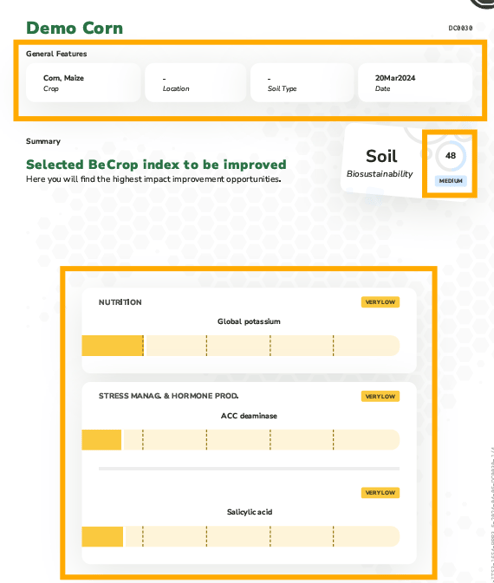
At the top you will see:
- Your sample description, Sample ID, crop, location, soil type, and sampling date.
- Overall BeCrop® Score for soil biosustainability on a 0–100 scale.
- Top 3 priorities to focus on. Example: high disease risk for a crop, low biocontrol agents, or low salt tolerance.
Color legend used throughout the report:
- Dark yellow: very low
- Dark blue: very high
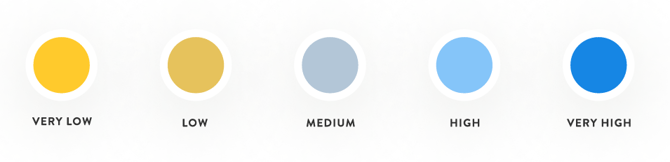
Tip: For risk metrics (for example, disease risk), “very low” is good. For most functional metrics, aim for medium to very high.
2) Community Snapshot
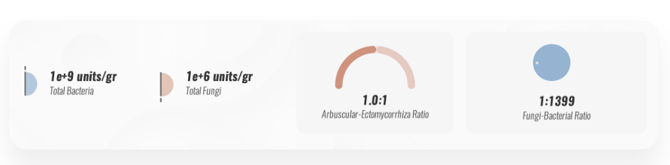
You will see:
-
Total number of species detected.
-
Relative abundance of bacteria and fungi and the bacteria:fungi ratio. This ratio is informative, tracked over time, and can reflect management practices.
-
Note on PLFA: PLFA reports biomass. BeCrop® shows relative abundance from DNA sequencing, so the numbers are not directly equivalent.
-
Mycorrhizal overview: arbuscular and ectomycorrhizal fungi may be present or absent depending on the sample.
A small phylum-level chart provides a quick sense of how broadly your microbes are distributed across major groups.
3) Core Soil Quality Indices
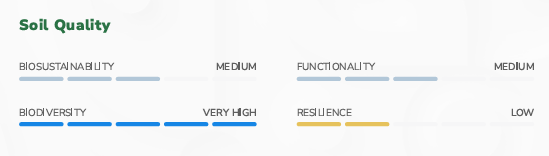
These indices are shown as quintiles on the 0–100 BeCrop® Score:
-
Soil Quality: reflects ecological interactions among microbes. Higher soil quality suggests more cooperation and symbiosis. Lower values indicate more competition and niche partitioning.
-
Functionality: diversity of microbial roles. Think of a community with many occupations working together.
-
Biodiversity: who is present. You can have high biodiversity with overlapping functions, or lower biodiversity with highly capable specialists.
-
Resilience: ability of the soil community to maintain function under stress, such as drought, floods, tillage, or pathogens.
Reading quintiles:
- 0–20 very low, 20–40 low, 40–60 medium, 60–80 high, 80–100 very high.
- Example: a “medium” bar means your sample sits in the 40th to 60th percentile for that crop.
4) Disease Risk
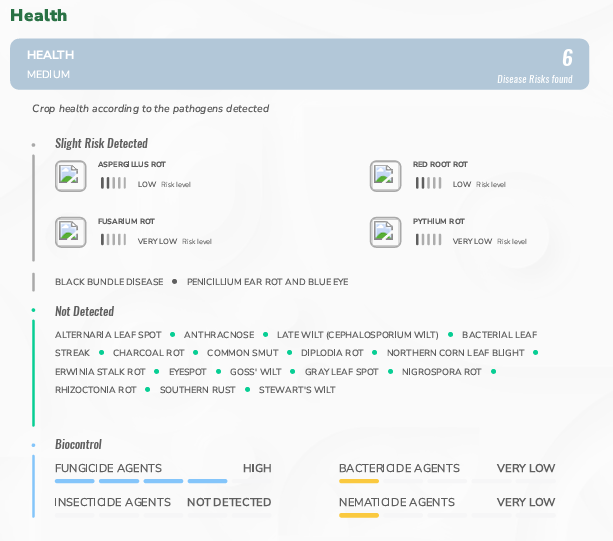
- Crop-specific disease risks are shown with their risk level.
- Example: late blight risk very high for tomatoes when Phytophthora infestans signals are strong.
- Additional diseases may appear at low risk.
- The report lists other diseases that were screened for this crop. If you care about a disease not listed, ask us to check database coverage before sampling.
How risk is built:
- Based on pathogen abundance and the ecological relationships within your soil microbiome, normalized within the same crop.
5) Biocontrol Agents
- Scores for microbial groups associated with natural suppression: fungicide, insecticide, and nematocide related agents (microbes, not insects or nematodes themselves).
- Low levels suggest limited natural antagonism and may guide biocontrol or input decisions.
6) Hormones and Stress Adaptation
Two parts appear here:
Plant growth regulators
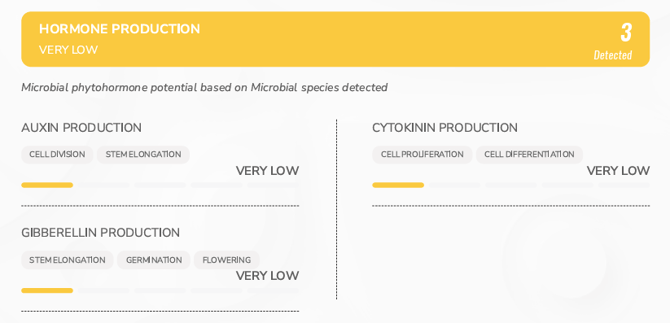
- Auxin (IAA), cytokinin, gibberellin.
- Important for establishment, growth, and yield. Low scores can help explain stand or yield limitations.
Stress-related functions
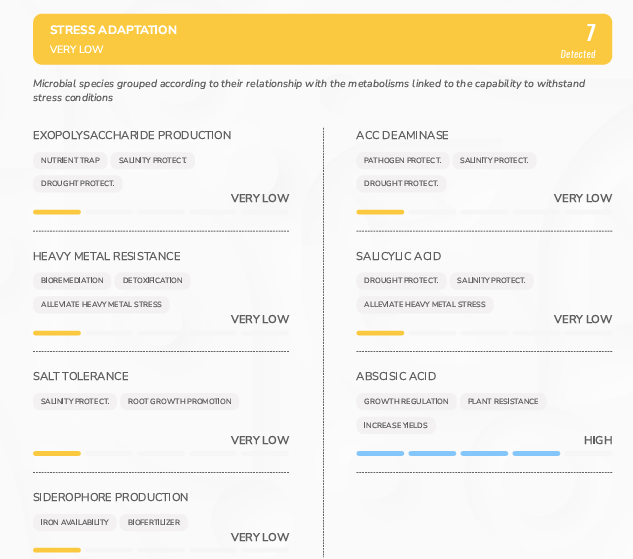
- ACC deaminase, salicylic acid, abscisic acid support pathogen tolerance, drought tolerance, and general stress response.
- Heavy-metal resistance and other secondary metabolites support detoxification and bioremediation.
- Siderophore production supports iron acquisition during stress.
- Exopolysaccharide (EPS) production relates to soil aggregation and structure, often called the “glue” that helps form stable soil.
Low values in these areas flag opportunities to strengthen stress resilience and crop performance.
7) Nutrition: Carbon, Nitrogen, Phosphorus, Potassium
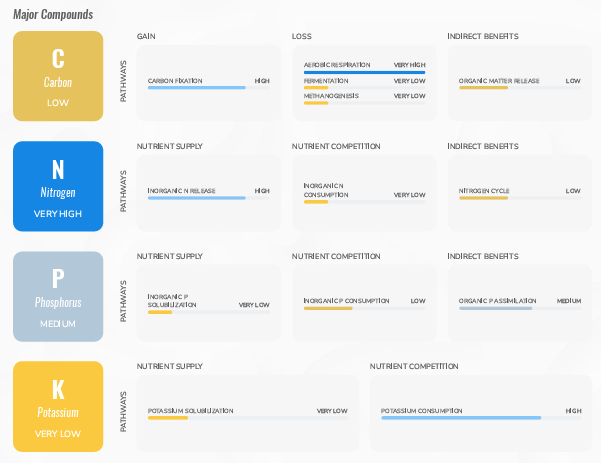
BeCrop® does not report ppm of nutrients. It reports functions that gain or lose plant-available forms. You will see gain pathways on the left and loss pathways on the right.
Carbon
-
Gain: fixation and organic matter release.
-
Loss: aerobic respiration, fermentation, methanogenesis.
-
Anaerobic conditions can increase fermentation and methanogenesis. A very low methanogenesis score is positive.
Nitrogen
-
Focus on inorganic N release and related competition.
-
Indirect benefits of nitrogen cycling may appear low or high, which can guide practice adjustments.
Phosphorus and Potassium
-
Solubilization indicates conversion of insoluble forms into plant-available forms.
-
Organic phosphorus assimilation shows conversion from organic to inorganic forms.
-
Competition indicates other microbes using P or K, potentially reducing availability to plants.
The colored overall rating summarizes how pathways balance out for each element.
8) Micronutrients
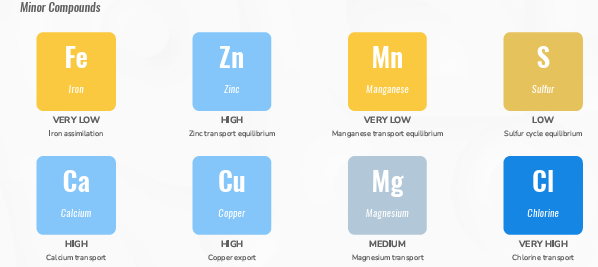
Shows microbial functions linked to delivery or availability of Fe, Zn, Mn, S, Cl, Mg, Cu, Ca.
-
Very low to very high bands indicate relative capacity of the microbiome to support each nutrient.
-
Use these signals to investigate specific micronutrient issues you see in the field or in tissue tests.
Putting It Together
A practical way to use the report:
-
Note the Top 3 priorities on the summary page.
-
Check disease risk and biocontrol to understand protection vs. pressure.
-
Review hormones and stress adaptation for establishment, stress tolerance, and potential yield constraints.
-
Look at nutrient functions for C, N, P, K, then micronutrients to see where biology may be limiting or enabling plant access.
-
Track bacteria:fungi and mycorrhiza over time, since management can shift these balances.
What the Scores Mean
- All functional scores are normalized within the same crop using the BeCrop® database.
- The 0–100 BeCrop® Score maps to the familiar five-band color scale.
- Medium is not “bad.” It simply places your sample in the middle quintile for that crop.
Use repeat testing to monitor trends after changes in management.