

From Fusarium Risk to a Clear Planting Decision
A watermelon grower needed to decide where to prioritize plants grafted onto Fusarium-resistant rootstock. By comparing soil samples from two fields, BeCrop® Technology revealed a clear difference in Fusarium wilt risk before planting.
Share this
2
60 vs. 0
1
A planting decision that needed belowground evidence.
A watermelon grower in the North Florida and South Georgia region had a portion of the crop grafted onto Fusarium-resistant rootstock, along with susceptible plants.
Before planting, there was a practical question to answer: Which field had greater Fusarium pressure, and where should the resistant plants go?
BeCrop® Technology provided biological soil data from two fields to help inform that decision before planting.
““Two samples. All I looked at was a disease. And I made an economically highly consequential decision.”
Two fields. One planting decision.
The grower needed to understand whether Fusarium pressure differed between the two fields before deciding where to prioritize the resistant grafted plants.
Two composite soil samples, one from each field, provided the starting point for comparing disease risk belowground.
Two samples. One direct comparison.
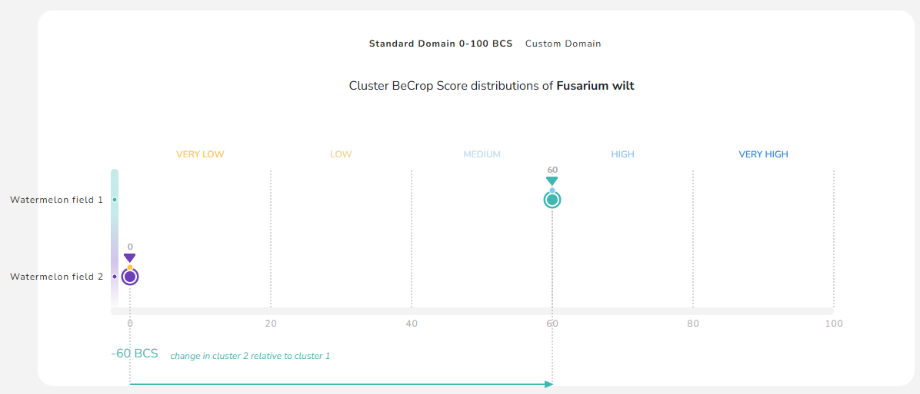
One composite soil sample from each field was analyzed with BeCrop® Technology. Using the Metric Box Plot tool in the BeCrop online portal, the two samples could be compared directly to identify the largest differences between them.
For this decision, the analysis focused specifically on disease risk.
A composite soil sample was collected from each of the two fields.
The Metric Box Plot from the BeCrop Portal was used to compare the two samples and identify differences in disease-risk scores.
The comparison provided biological information to help determine where the resistant grafted plants should be prioritized.
Fusarium wilt risk differed sharply between the two fields.
Field 1 scored 60. Field 2 scored 0.
The BeCrop comparison revealed a clear difference in Fusarium wilt risk between the two fields. Field 1 had a risk score of 60, while Field 2 had a score of 0, where Fusarium wilt was not detected in the sample.
This was a notable result. Across BeCrop’s watermelon soil samples, Fusarium is detected to some level in approximately 80% of samples.
The results helped guide where to place the resistant plants.
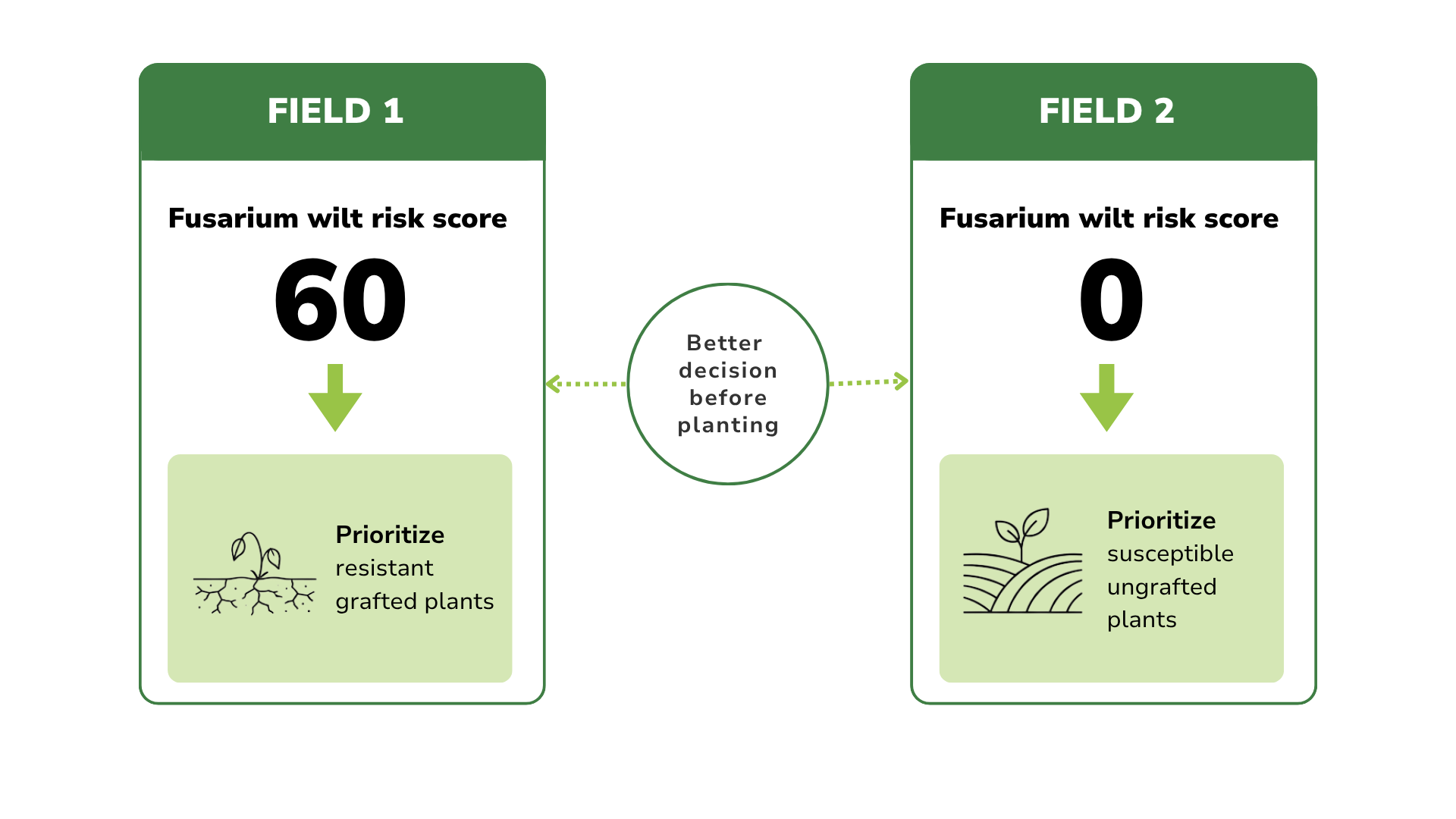
With higher Fusarium wilt risk identified in Field 1, the resistant grafted plants could be prioritized there.
Field 2 presented much lower risk, with Fusarium wilt not detected in the sample, providing greater confidence in placing the susceptible ungrafted plants there.
Disease risk data becomes more valuable when it helps answer a field question.
Detecting a pathogen is useful. In this case, understanding how Fusarium wilt risk differed between two fields helped turn that information into a practical pre-planting decision.
With just two composite soil samples, BeCrop® Technology provided another layer of information the grower could use alongside agronomic knowledge to decide where resistant plants should be prioritized.
See what differs from field to field.
Compare disease risk between fields
Identify where Fusarium pressure is higher
Add biological information before planting
Turn biological data into practical guidance.
Prioritize where resistant plants should go
Use field-specific risk to support plant placement
Bring another layer of information into crop protection decisions
Bring biological insight into your crop protection decisions.
BeCrop® Technology helps growers and agronomists understand what is happening belowground, adding biological information to support more informed decisions around disease risk and crop management.