
Using Soil Biology to Guide Fusarium Risk Management in Watermelon
How BeCrop® Technology helped a grower compare disease risk across two fields and decide where to prioritize resistant plants
Fusarium wilt can be a serious challenge for watermelon growers. For growers managing Fusarium wilt risk, grafting plants to resistant rootstocks can be one part of the crop protection strategy. But when both resistant and susceptible plants are available, growers still need to decide where those resistant plants will be most valuable.
For a watermelon grower in the North Florida and South Georgia region, BeCrop® Technology provided another layer of information to help make that decision before planting.
Share this

Results at a glance
Fields analyzed
Fusarium wilt risk
Clear planting decision
The Challenge
The grower had ordered a portion of their watermelons grafted onto Fusarium-resistant rootstock, while the remainder of the supply was ungrafted plants.
The question was simple: Which field had greater Fusarium pressure, and where should the resistant plants go?
Knowing this before planting could help the grower use the resistant plants where they were most needed instead of making the decision without information about what was happening belowground.
What BeCrop® Revealed
One composite soil sample from each field was analyzed using BeCrop Technology to understand the soilborne disease risk.
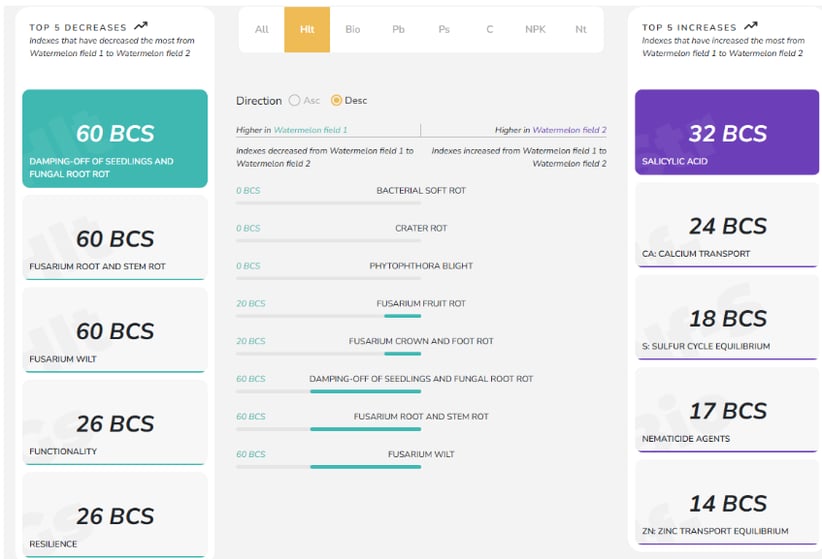
The results showed a clear difference: field 1 had a Fusarium wilt risk score of 60. Field 2 had a score of 0, meaning Fusarium wilt was not detected in that sample.
The result from Field 2 was particularly notable. Across BeCrop’s watermelon dataset, Fusarium is detected to some degree in approximately 80% of soil samples. Finding no detectable Fusarium wilt in Field 2 therefore created a clear contrast with the higher-risk Field 1.
From Soil Data to a Planting Decision
The results gave the grower a practical way to decide where to prioritize the resistant plants. With higher Fusarium wilt risk identified in Field 1, the resistant grafted plants could be prioritized there, while the susceptible ungrafted plants could be placed in Field 2, where Fusarium wilt was not detected.
Instead of waiting for symptoms to appear, the grower could use information about disease pressure before planting to help guide the decision.
Why It Matters
Finding a pathogen is useful. Knowing how that information can support a field decision is where it becomes actionable.
In this case, BeCrop helped identify a meaningful difference in Fusarium wilt risk between two fields before planting. That information gave the grower another piece of evidence to decide where resistant rootstock should be prioritized.
The same approach can help growers and agronomists use soil biological information alongside their field knowledge when making decisions around resistant varieties and rootstocks, field selection, rotations, scouting, and other crop protection strategies.
From Pathogen Detection to Actionable Soil Intelligence
BeCrop Technology helps turn what's happening belowground into information growers and agronomists can use in the field.
For this watermelon grower, the question was straightforward: Where should the resistant plants go? BeCrop provided the soil biological insight to help answer it.
Ready to bring soil intelligence into your crop protection strategy?
Request a demo!
BeCrop Technology
The ultimate decision-making tool for agriculture
Download .PDF
Get in touch!
We are happy to answer your questions.
Get a quote
Use BeCrop in your farmland today